
Applications are open now. Members apply free. Apply now to be recognized at the Gala in 2027.
Applications are open now. Members apply free. Apply now to be recognized at the Gala in 2027.
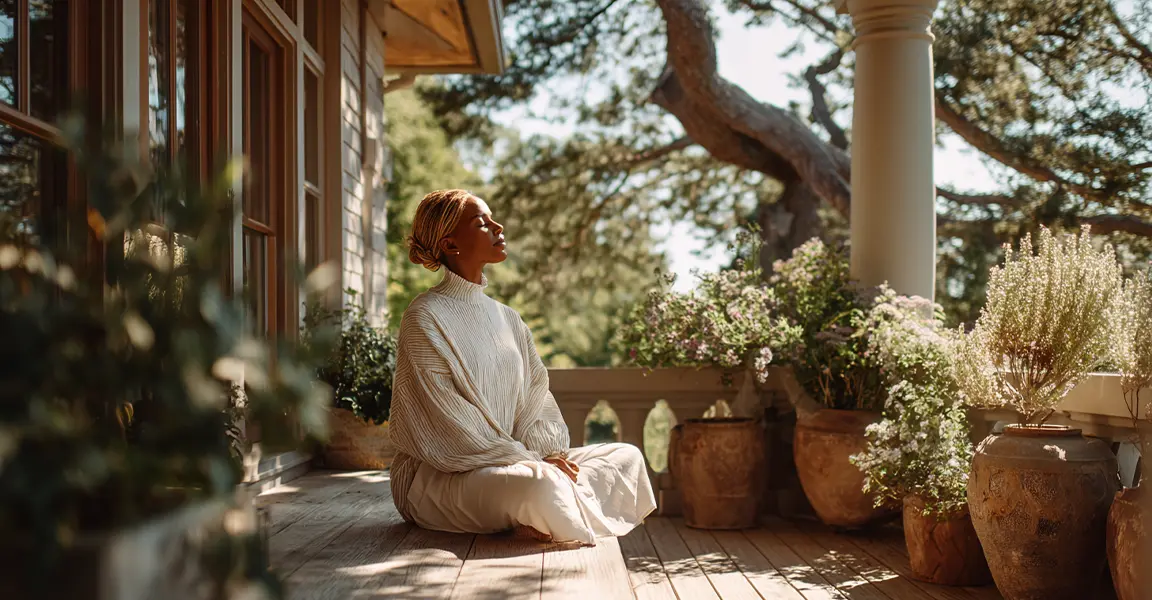
There is a moment that happens to a lot of women in the middle of a Saturday. The morning chores are done. The afternoon is open. No one needs anything immediately. You sit down on the couch with a cup of tea, and within about three minutes, your hand reaches for your phone, or your body stands up to start another task, or your mind begins running through everything that needs doing this week. The stillness lasts almost no time at all. You did not choose to break it. Your body broke it for you, because the stillness felt unfamiliar in a way that bordered on unsafe.
This is what it looks like to have forgotten how to rest. The forgetting is not a moral failing. It is a nervous system trained over years to stay alert, productive, useful, responsive. When you ask such a system to suddenly settle, it cannot. It does not know how. The settling has to be relearned slowly, the way you would relearn any skill that has gone dormant. And the relearning is gentler than you might expect.
I want to talk about what rest actually is, because I think most of us have been given a version of rest that does not work. The version we have been given is mostly about activity. Yoga. Meditation. Bubble baths. Walks in nature. Adult coloring books. The activities themselves are fine, but they are not rest. They are pleasant ways to occupy yourself. Real rest is something quieter and slower, and it does not always look like anything from the outside.
What Rest Actually Is
Rest, in the way I mean it here, is the experience of letting your nervous system come down from its baseline state of alertness. Most women I know are walking around in a state of low-grade activation almost all the time. The body is ready to respond. The mind is scanning for the next thing. The shoulders are slightly tense. The breath is shallow. None of this registers as stress, exactly. It just feels like normal. But it is not normal. It is the body adapting to conditions that require constant readiness, and over time, the adaptation becomes invisible to you.
Real rest is what happens when the body finally decides it is safe enough to stop adapting. The shoulders drop. The breath deepens. The jaw unclenches. The mind slows down to the pace of the body. None of this can be willed into happening. It happens when the conditions allow it, and the conditions usually require time, quiet, and the absence of any demand to perform or produce anything. This is why rest so often eludes the women who need it most. The conditions that would allow rest are the conditions that their lives almost never provide.
The first time you experience real rest after a long period of not having it, the experience can be disorienting. Your body may feel heavier than you remember. You may notice tiredness you had been holding off. You may find yourself crying without knowing why. These responses are not problems. They are what happens when a body that has been bracing finally puts down what it was carrying. The body needs to release what it had been holding before it can settle into anything that feels like ease.
Why Your Body Will Not Let You Rest
If you have tried to rest and found that your body would not cooperate, you are not failing at rest. You are encountering the protective patterns that your nervous system built to keep you functional. These patterns developed for good reasons. They probably helped you get through difficult periods of your life. The trouble is that nervous systems do not always know when to stand down. The patterns that protected you during a hard time can continue running long after the hard time has passed, and they can prevent you from accessing the rest you now need.
The body wants to keep you safe. To a nervous system that learned safety came from staying alert, slowing down can feel like a threat. When you try to rest, the body sounds an internal alarm. The hand reaches for the phone. The mind generates a list of urgent tasks. The legs stand up to do something productive. None of this is conscious. It is the protective system doing its job, which is to prevent you from doing the very thing that would help you most.
This is part of why simply telling yourself to rest does not work. The system is older and stronger than the conscious intention. You cannot will yourself into a state of nervous system safety. You have to gently teach the system that it is safe to settle, and the teaching takes time and repetition. The teaching also requires patience with a body that may resist the very thing you are trying to give it. The resistance is not a problem to be solved. It is information about how long the body has been working without permission to stop.
Starting Smaller Than You Think
The mistake most women make when they finally decide to rest is starting too big. They book a weekend retreat. They take a week off work. They try to commit to a daily meditation practice. The big interventions sometimes work, but more often they do not, because the body cannot make the jump from constant activation to deep rest in a single weekend. The body needs to be coaxed, not commanded. The coaxing has to start at a scale the system can tolerate.
Begin with two minutes. Not twenty. Two. Find a place where no one will interrupt you. Sit down or lie down. Close your eyes if you can. Do not try to clear your mind. Do not try to do anything. Just notice that you are breathing, and notice what your body feels like, and let two minutes pass. When the urge to do something arises, which it will, notice the urge without obeying it. When the two minutes end, get up and continue with your day. You have just given your nervous system a small dose of permission to stop. That is the entire practice.
Do this once a day, every day, for a week. The first few times will feel strange. Your body will protest. Your mind will fill with tasks. You will feel restless and slightly anxious. This is what it looks like to teach a nervous system that has forgotten safety how to begin to remember it. The protest is part of the work. After about a week of two-minute practices, you will start to notice something. The two minutes will become slightly easier. The body will begin to anticipate the small daily pause and may even begin to look forward to it.
Once two minutes feels stable, you can extend to five. Then to ten. The progression is not linear. Some days will be harder than others. The point is not to perfect a rest practice. The point is to slowly retrain the body to recognize that stillness is not a threat. Each small practice is a deposit in a bank that has been overdrawn for a long time. The deposits add up, but only if you make them consistently and at a scale that the body can absorb.
The Other Kinds of Rest
There is a concept that has been useful to a lot of women I have talked to, which is that there are different kinds of rest, and most of us are deficient in several of them at once. Physical rest is the most obvious one, which is what we get from sleep. But there is also mental rest, which is what we get from putting down the cognitive load of work and decision making. Emotional rest is what we get from not having to manage anyone else's feelings for a while. Social rest is what we get from being alone or with people who do not require us to perform. Sensory rest is what we get from quiet and dim light. Creative rest is what we get from absorbing rather than producing. Spiritual rest is what we get from feeling connected to something larger than our individual concerns.
Most exhausted women I know are well-rested in maybe one of these categories and depleted in the others. They sleep enough but never get a break from making decisions. They are alone often but never escape the mental load. They watch shows for hours but never give their senses real quiet. Knowing which kind of rest you are missing can help you understand why the rest you have been getting does not feel restorative. You may not need more sleep. You may need quiet, or solitude, or a break from caretaking, or any of the other forms of rest you have not had in a long time.
Take a few minutes sometime this week to think about which of these you are most starved for. Be honest. The answer often surprises women, because we tend to assume our exhaustion is about sleep when it is often about something else entirely. Once you know which kind of rest your body is asking for, you can start to plan small ways to give it that specific kind. A walk alone, with no podcast, for ten minutes. An afternoon where no one asks you for anything. An hour in a dim, quiet room. These small specific interventions often do more than a weekend off, because they are addressing what is actually missing rather than guessing.
The Permission Problem
Underneath all of this is a deeper issue, which is that most women have not given themselves permission to rest. They have given themselves permission to recover from being sick. They have given themselves permission to take a vacation if it is scheduled and earned. They have given themselves permission to sleep when they cannot stay awake any longer. But the basic permission to rest without justification, without earning it first, without having a productive reason for it, is something most of us have never extended to ourselves.
This is partly cultural. Women are still operating in a world that values productivity over almost everything else, and that quietly punishes women who appear to be unproductive in ways it does not punish men. The cultural message has been absorbed so deeply that most of us do not even notice we are operating under it. We rest only when we are too broken to keep going, and then we feel guilty about it, and we return to working as quickly as possible. The cycle keeps us depleted and convinced that the depletion is normal.
Granting yourself permission to rest, without earning it, is a small act of rebellion. It is the practice of believing that you are valuable even when you are not producing anything. This is a belief that has to be practiced, because none of us were raised to believe it, and the world is constantly telling us otherwise. The permission is not something you can wait to feel. It is something you have to extend to yourself, deliberately, again and again, until the giving of permission becomes part of how you move through your days.
What to Notice Along the Way
If you begin to practice rest, even in small doses, you will start to notice things. The first thing you may notice is how tired you actually are. Most women have been pushing through exhaustion for so long that they do not feel the exhaustion clearly anymore. When you slow down, the body finally has space to tell you how tired it is. This can be alarming. It is not a sign that rest is making things worse. It is a sign that you have finally given the body enough space to be honest with you.
The second thing you may notice is feelings that you had been managing through busyness. Sadness, anger, grief, fear, loneliness. The busyness of an overactive life often serves the function of keeping us from feeling things that we do not have time to feel. When the busyness slows, the feelings rise. This is not a problem with rest. It is what rest is for. The body needs space to process what it has been carrying. The processing is uncomfortable in the moment and useful in the long run.
The third thing you may notice is small returns of pleasure. The first sip of coffee tasting better than it has tasted in months. The feeling of sun on your face actually registering. A piece of music moving you in a way you had not been moved in a long time. These returns are what happens when a depleted nervous system starts to come back online. The capacity for pleasure had not been gone. It had been buried under the constant activation. Rest gives it room to return.
What This Is Really About
The practice of rest is not about becoming a different kind of person. It is not about becoming someone who meditates for an hour each morning or who takes long baths every weekend. It is about giving your body the basic experience of being allowed to stop. The experience changes you. Not dramatically. Not visibly. But over time, the woman who has learned to rest is steadier, clearer, kinder to herself and others, less easily knocked over by the small ordinary difficulties of being alive.
This is what Bloom was built for. The slow daily work of giving yourself permission to feel what you feel, rest when you need to rest, and stop performing the impossible standard of constant productivity. The practice of rest is one of the most important things we can offer ourselves. Not because we have earned it, but because we are human, and humans are not designed to run without pausing.
Start with two minutes. Tomorrow. Just two. See what happens. The relearning begins with the smallest possible step, and the smallest possible step is enough to begin.