
Applications are open now. Members apply free. Apply now to be recognized at the Gala in 2027.
Applications are open now. Members apply free. Apply now to be recognized at the Gala in 2027.
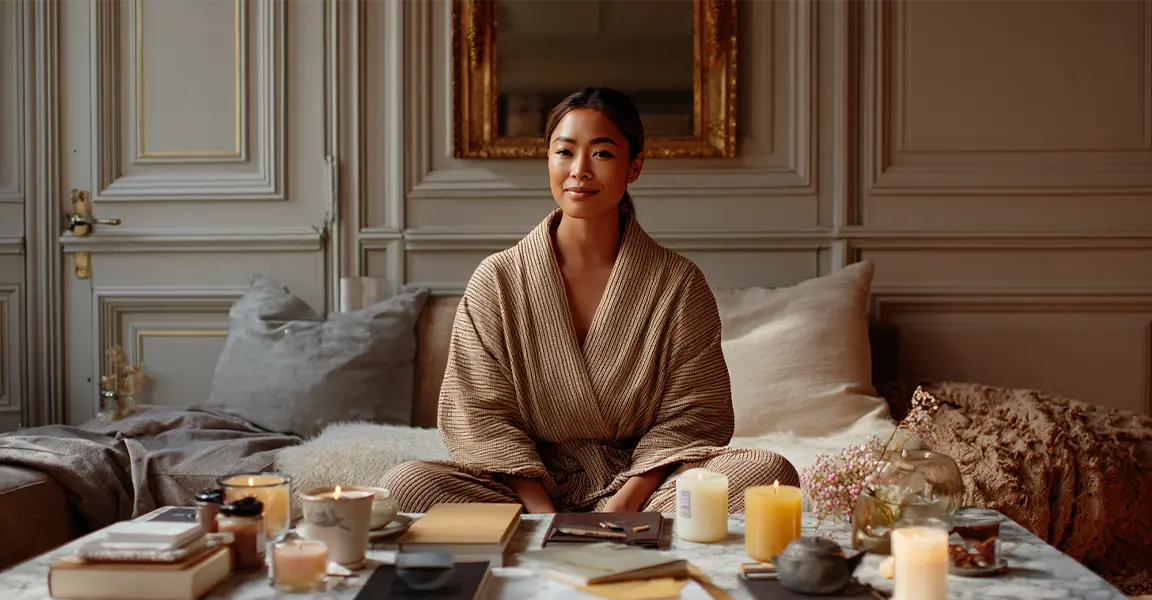
The phrase self-care entered the cultural bloodstream in the 1970s through the writing of Black feminist activists who used it to describe something specific and political. Audre Lorde, in her 1988 essay collection A Burst of Light, wrote that caring for herself was not self-indulgence but self-preservation, and that this was an act of political warfare. She was writing as a Black lesbian woman with cancer, navigating a medical system that did not see her, in a culture that did not protect her. Self-care, in her hands, meant the deliberate refusal to be ground down by systems designed to grind her down. It was survival. It was resistance. It was not a bubble bath.
Something happened to that phrase between Lorde's writing and the present. The words remained. The meaning was hollowed out and replaced with something that bears almost no resemblance to what Lorde was describing. Self-care became a product category. It became a marketing hook. It became something women could buy, perform, post about, and feel temporarily better while the conditions that exhausted them continued unchanged. The phrase that began as a description of political survival was repackaged as a consumer behavior, and most of us did not notice the swap.
The Quiet Theft
The wellness industry, valued globally at over five trillion dollars according to the Global Wellness Institute's 2024 report, has been the primary beneficiary of this transformation. Self-care, in the industry's framing, is something you do by purchasing. A candle, a face mask, a yoga retreat, a meditation app subscription, a planner, a wellness drink, a spa day. The list of things you can buy to perform self-care has expanded every year for the last decade. The promise underneath every product is the same. If you just purchase the right thing and use it in the right way, the exhaustion you are carrying will lift.
This promise does not deliver, but it does not have to. The genius of the marketing is that when the product fails to produce lasting relief, the failure gets blamed on the consumer rather than the product. You did not commit to the practice. You did not buy the right one. You need to spend more. The cycle is built to continue. Women have been told for over a decade that their exhaustion is a personal failing that can be addressed through individual purchases, and we have responded by spending more on self-care products than perhaps any consumer category in history, while reporting record levels of burnout.
The data tells the story. A 2024 American Psychological Association survey found that nearly two-thirds of women reported feeling overwhelmed by stress, the highest figure recorded since the survey began. Over the same period, sales of products marketed as self-care continued to grow at double digit rates annually. We are buying more and feeling worse. The products are not solving the problem they were sold to solve. They are not designed to. They are designed to produce repeat purchases, and the repeat purchases require that the underlying problem remain unresolved.
What Got Lost
What got lost in the translation from political survival to consumer product is everything that made the original concept useful. Lorde's self-care required nothing to be purchased. It required you to recognize the systems that were trying to deplete you, name them honestly, and refuse to collaborate with your own depletion. It required community, because no one can resist a depleting system alone. It required honesty about anger, grief, and exhaustion rather than the performance of serenity. It required structural awareness, because individual coping cannot fix structural harm. It was demanding, communal, political, and free.
The consumer version requires the opposite. It requires you to locate the problem inside yourself. It requires you to perform calm rather than express anger. It requires you to address structural exhaustion with individual purchases. It requires you to spend money you may not have on products you have been told will fix something the products cannot fix. It strips out the politics, removes the community, and leaves you alone with your credit card and your candle, wondering why you still feel the same way you felt before you bought the candle.
The deepest loss may be the loss of permission to be honest about what is actually happening. The performance of self-care often requires women to suppress the very feelings that would prompt real change. You cannot say you are furious about your workload while sipping your adaptogenic latte and posting about your morning routine. The aesthetic requires a particular kind of feminine calm that papers over the actual experience of being a woman in a world that demands too much. The papering over is not incidental. It is the product. Women who stop performing calm and start naming the real conditions of their lives become harder to sell to.
The Difference Between Care and Self-Care
There is a useful distinction that the consumer version has erased. Care, the actual practice of attending to a human being, is real and necessary. It involves things like adequate sleep, nourishing food, movement, time outdoors, connection with people who know you, medical attention when needed, and rest that does not require justification. These practices have always been part of being human. They do not require a marketing apparatus. They cost very little money. They produce real results.
Self-care, in the consumer sense, is a narrower and stranger thing. It is care performed for an audience, often through purchases, often with documentation. It is care that signals something to others rather than restoring something in yourself. The two practices look similar on the surface, but they produce different outcomes. Real care produces a woman who is steadier, more honest, more capable of saying what she means. Performed self-care produces a woman who has spent money and posted photos but does not feel meaningfully different from the woman she was before.
This distinction matters because most women are not actually short on care, in the consumer sense. They have the candles. They have the apps. They have the products. What they are short on is the structural conditions that would allow care to function, which is to say, time, support, permission to rest without justifying it, communities that hold them, work that does not extract more than it returns, and political conditions that recognize their humanity rather than treating their exhaustion as a personal failing. None of this can be purchased.
Who Benefits From This Confusion
It is worth asking who benefits from a culture that has confused care with consumption. The most obvious beneficiary is the wellness industry itself, which has built an enormous business on the gap between what self-care promises and what it delivers. But the benefits extend further. Employers benefit when burnout gets framed as an individual problem that workers can solve through personal practices, rather than a structural problem that would require changes to workloads, hours, and expectations. Insurance companies benefit when stress related health issues get treated through individual wellness products rather than through actual healthcare. Political systems benefit when the exhaustion produced by inadequate policy gets addressed through consumer products rather than through demands for better policy.
The consumer self-care framing relocates a structural problem into an individual responsibility. This is convenient for the systems that produced the structural problem. It is not convenient for the women living through it. A woman who believes her exhaustion is her fault, and who tries to solve it through purchases, will not organize her colleagues. She will not push for policy change. She will not name what is actually happening at her workplace or in her life. She will buy another product and try again. The political potential of her exhaustion stays trapped inside the individual frame.
This is what Lorde was warning against when she described self-care as political warfare. She understood that the depletion of women, particularly women of color, was not accidental. It was the result of systems that benefited from that depletion. Care, in her hands, was the refusal to let those systems win. The consumer version of self-care lets the systems win every time, because it never addresses the systems at all.
What Real Care Might Look Like
If the consumer version of self-care has failed to deliver what it promised, what should women do instead? The honest answer is that we should return to the harder, slower, less photogenic work of actual care, which has never gone away even as it has been overshadowed by its consumer doppelganger. Real care looks like getting enough sleep, which often requires saying no to commitments that would prevent it. Real care looks like eating food that nourishes you, which often requires more time than the convenience economy wants you to spend. Real care looks like moving your body in ways that feel good rather than punishing, which often requires letting go of the fitness industry's narrative about what your body should look like.
Real care also looks like the harder work of building the structural conditions that make care possible. This includes setting limits at work, asking for help at home, ending relationships that deplete you, choosing communities that restore you, and saying what you actually feel instead of what is expected. None of this is glamorous. None of it requires a product. All of it requires courage that the consumer version of self-care does not develop. The candle does not teach you to say no. The face mask does not give you a way to push back at your boss. The wellness retreat does not change the conditions you return to when it ends.
The most political form of care, in Lorde's sense, is the care women extend to each other. Communities of women who hold each other through hard seasons, who name what is happening, who refuse to pretend that individual effort is enough, who make space for honesty rather than performance, are doing the work that consumer self-care cannot do. This kind of care does not scale into a business model. It does not generate quarterly revenue. But it produces women who are actually steadier, actually more capable, actually able to live the lives they want to live. It is what self-care was always supposed to mean.
Returning to the Original
There is no shame in having bought into the consumer version. Most of us did. The marketing was sophisticated, the products were appealing, and the alternative, which requires us to confront structural conditions we cannot easily change, is genuinely harder. The point is not to criticize women for spending money on candles. The point is to notice that the candles did not work, and to ask what might.
Returning to the original meaning of self-care requires giving up the fantasy that the right purchase will fix what is actually wrong. It requires looking at the conditions of our lives and asking whether they are sustainable, regardless of how many wellness products we apply to them. It requires building the kind of community Lorde was describing, which is harder than ordering from a wellness brand but produces results the brand cannot.
The phrase self-care, in its current form, has been so thoroughly captured by the consumer economy that it may no longer be recoverable. We may need different words for what we actually need. Care. Rest. Community. Refusal. Boundaries. Sleep. Honest conversation. Political action. None of these words are as marketable as self-care, which is precisely why they describe something the marketers cannot sell us. They describe what women actually need, which is the same thing women have always needed, which is the same thing Audre Lorde was writing about when she chose those two words almost forty years ago.
We could return to her meaning. We could remember that care is not something we purchase. We could rebuild the communities and conditions that make real care possible. The wellness industry will continue to sell us things, and some of those things will be pleasant. But the work of caring for ourselves, in the way Lorde meant, was never going to be solved by what we could buy. It was always going to require what we could refuse, what we could demand, and what we could build together. That work is still available to us. The candle was always optional.