
Applications are open now. Members apply free. Apply now to be recognized at the Gala in 2027.
Applications are open now. Members apply free. Apply now to be recognized at the Gala in 2027.
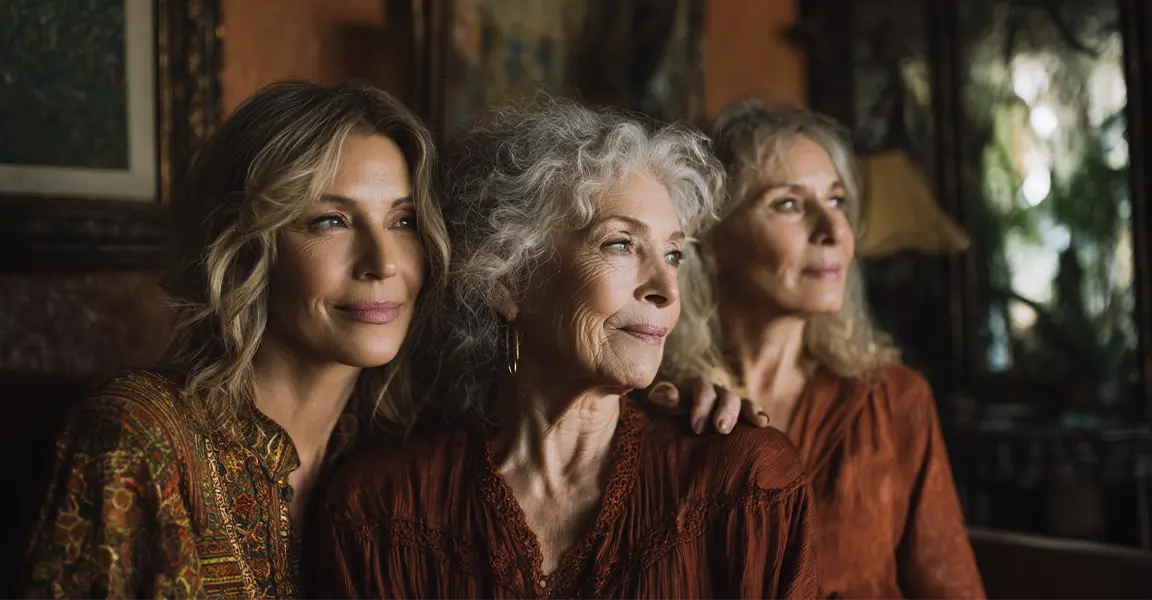
My grandmother died with a recipe in her head that she never wrote down. It was for a stew she made every Sunday, the kind that took most of the morning to assemble and most of the afternoon to cook, and the kitchen smelled like it for two days afterward. She taught my mother how to make it, by which I mean she let my mother watch her make it a few hundred times. My mother taught me the same way, with adjustments she had made over the years that she did not always announce, and now I make a version that contains traces of both of them and also some changes I have made that neither of them would have approved of. The stew exists now in three different forms across three women, and the through line, if you traced it, would tell you something about us that none of us would have known how to say in words.
This is what inheritance among women often looks like. It is not the silver, the property, the things mentioned in a will. It is the recipe she never wrote down, the gesture you catch yourself making, the way you hold your jaw when you are angry, the words you find coming out of your mouth that you swore as a teenager you would never say. The inheritance arrives without ceremony. It does not ask whether you wanted it. It just becomes part of you, sometimes for decades before you notice, and the noticing is its own kind of conversation with the women who came before you, whether they are still alive or not.
What Passes Without Being Named
The most powerful inheritances tend to be the ones nobody talked about. The ways your mother responded to stress. The relationship her mother had with food. The particular silences in your family around grief. The phrases that get repeated across generations without anyone tracing them back to their source. These pass quietly, often without the older woman realizing she is passing them along, certainly without the younger woman realizing she is receiving them. By the time you are in your thirties or forties, you are walking around with a layered inheritance that you did not consciously absorb and that you do not consciously remember being taught.
There is research now on what social scientists call intergenerational transmission, which is the formal name for how patterns move through families across generations. Studies have documented that everything from coping strategies to communication patterns to relationships with money to attitudes about the body can be transmitted from mother to daughter to granddaughter, often without explicit teaching and often without the women involved knowing it is happening. The mother who never talked to her daughter about food may have communicated more about food through her own eating, her comments about her own body, her treatment of certain foods as virtuous or shameful, than she would have if she had sat the daughter down for a conversation. The daughter, decades later, will find herself making the same gestures her mother made around her own body, and she may not remember her mother making those gestures at all.
This is not always negative. Many of the inheritances women carry are gifts. The grandmother who modeled how to host a room, how to make a stranger feel welcome, how to handle a difficult guest with grace. The mother who modeled how to keep going through hard times without becoming bitter. The aunt who showed you what it looks like to take your own ambition seriously. These models do not always come with explicit instruction. They come through observation, through repetition, through the cumulative effect of being in the presence of a woman who lives in a certain way. You absorb the way of being before you understand it as a way of being, and it becomes part of how you move through the world.
The harder inheritances are the ones that arrived without warning and that have shaped you in ways you may resent. The mother whose anxiety became your anxiety. The grandmother whose relationship with secrecy taught your family how to keep important things unspoken. The pattern of women in your family marrying men who diminished them, which you may have repeated before you understood the pattern. These inheritances are not your fault. They are also yours to carry now, and the work of deciding what to do with them is some of the most significant work a woman can do in her own life.
What Gets Lost
There is also an inheritance that often does not pass, and the loss of it shapes generations of women in ways that are hard to see because we do not have access to what we never received. The skills our great-grandmothers had that our grandmothers did not learn. The medical knowledge that lived in midwives and herbalists before that knowledge was systematically discredited. The community structures that supported women through the work of raising children and caring for the elderly and managing households before those structures were dismantled in favor of an isolation that we have been told is independence. The losses are real, and they are usually invisible because we have no memory of what we no longer have.
My grandmother knew things about food, about plants, about caring for sick children, that my mother never learned because by the time my mother was raising children, the cultural authority on these matters had moved to pediatricians and grocery stores and the women's magazines that sold us convenience. My mother knew things about community, about reciprocal care among neighbors, that I never learned because by the time I was an adult, the suburbs had broken those networks and I was raising my own family in a context where neighbors barely knew each other. Each generation lost something the previous generation had taken for granted, and the losses accumulated, and now there are women in their thirties who have never seen another woman give birth and have no model for what it looks like to hold a baby with confidence.
The losses are not the fault of the individual women in the chain. They are the result of structural changes in how women lived, what work they were expected to do, how communities were organized. But the inherited absence still has weight. The woman who is now trying to parent without the village her grandmother had access to is doing something her grandmother would have recognized as impossible. The woman trying to manage her household alone is doing the work that used to be done by extended families and neighborhoods. The loss of these structures means that contemporary women are often performing the work of generations of women all by themselves, and the exhaustion this produces is real, and it has historical roots.
What We Pass Without Knowing
Mothers and grandmothers often pass things they did not intend to pass. The mother who survived a hard marriage by becoming hyper-competent may have raised a daughter who learned that the way to be loved was to be useful. The grandmother who lived through a war and stored food obsessively may have raised a daughter who learned to fear scarcity even in plenty, and that daughter may have raised her own daughter to feel guilty about wasting things. The transmissions can be specific to particular families and particular histories, and they are often shaped by events the older women lived through that the younger women only know about indirectly.
The transmission also goes the other way, in ways that are less discussed. Daughters and granddaughters teach their elders things, sometimes deliberately and sometimes not. The grandmother who learns to use technology because her granddaughter taught her. The mother who softens her views on a subject because her daughter pushed back. The older woman who comes to see her own life differently because the younger women in her family ask questions she had never been asked before. The inheritance is not strictly one-directional. It moves in both directions, and the back transmission can be as significant as the forward one, particularly in families where the older women are willing to be changed by the younger ones.
This is part of what is happening in families where younger women are asking different questions than their mothers asked. The daughter who insists on therapy. The granddaughter who refuses to accept secrecy around family history. The young woman who names what previous generations would have left unnamed. Each of these conversations changes not only the woman who started it but also, often, the older women who are willing to be in the conversation. The inheritance shifts. The patterns that seemed inevitable turn out to have been changeable all along, once a younger woman was willing to ask whether they had to continue.
Choosing What to Carry
At some point in most women's lives, usually in the thirties or forties, there is a reckoning with what has been inherited. The reckoning often begins with a particular gesture or phrase that you catch yourself making, and you realize it is your mother's, or your grandmother's, and you have to decide whether you want to keep it. The decision is not always easy. Some of the inheritances are tangled together, the gifts and the wounds woven into the same fabric. You may want to keep the part that helps you and discard the part that hurts you, only to discover that you cannot easily separate them.
This is the work of becoming conscious of your own inheritance, and it is some of the most important work a woman can do in her own life. The unconscious inheritance runs you. The conscious inheritance you can work with. The patterns that have shaped you without your knowing can be examined once you become aware of them, and you can make choices about which ones to continue and which ones to interrupt. The interruption is not always clean. Some patterns are deeply embedded and will require years of attention before they shift. Others can be changed more quickly than you would expect, once you see them clearly.
A woman I interviewed for an earlier piece described the moment she realized she was passing her own mother's anxiety to her daughter. She had not seen herself as anxious. She had thought of her mother as the anxious one, and herself as different. But watching her daughter respond to small disruptions with the same nervous system pattern she remembered from her own childhood, she understood. The inheritance had not skipped her. It had moved through her without her noticing, and now her daughter was receiving it. She said it was one of the hardest realizations of her adult life, and also one of the most important, because it gave her the opportunity to do something about it. She started therapy. She started doing her own work. The inheritance did not have to continue, but only because she had finally seen it clearly.
This is what conscious inheritance looks like. It is the willingness to look at what you have received, to honor what is good about it, to name what is harmful, and to decide what you want to do next. The decision is yours. The previous generations cannot make it for you. You cannot make it for the women who come after you, but you can choose what you contribute to what they will inherit. The chain continues either way. The only question is whether you participate in the chain consciously or unconsciously.
What We Owe Each Other
There is something women owe each other across generations, even when the relationships are complicated, even when the older women hurt the younger women or the younger women have abandoned the older women. The owing is not about forgiveness, which is a private decision each woman has to make on her own. The owing is about honesty. The older women owe the younger women the truth about what they lived through, what they survived, what they wish they had done differently, what they want the younger women to know. The younger women owe the older women the willingness to ask. The conversation between generations of women is one of the most important conversations a woman can have, and it is one that the culture does not often make space for, particularly across the divides of class, race, and geography that have shaped women's lives.
The conversations are happening more now than they used to. Younger women are interviewing their mothers and grandmothers. Memoir is full of these conversations. Family history projects are documenting what previous generations were never asked. The conversations are sometimes joyful and sometimes painful, and they are almost always more revealing than the participants expected. The older women often have things to say that no one ever asked them to say. The younger women often discover that their inheritance is more complicated and more interesting than the simplified version they had been operating with.
If you have an older woman in your family who is still alive and who you can ask, ask her now. Ask her about her own mother. Ask her what she wishes she had known earlier. Ask her what she wants you to know. The conversation may be hard. It may not produce the answers you hoped for. It may open up things that you cannot close again. It will also give you information about your inheritance that you cannot get any other way, and the information will shape your understanding of your own life in ways that nothing else can.
The Weight and the Gift
To be a woman is to carry, among other things, the weight of every woman who came before you. Not all of the weight is heavy. Some of it is the gift of strength they built, the wisdom they passed, the ways they figured out how to live that you get to inherit without having to figure out yourself. Some of it is heavier, the patterns you have to interrupt, the silences you have to break, the assumptions you have to question. The work of being a conscious heir, of looking honestly at what you have received and deciding what to do with it, is some of the most important work of any woman's life.
The work continues after you. Whatever you carry will become part of what you pass, whether or not you intend to pass it. The conscious heir becomes the conscious ancestor, and the next generation receives a slightly different inheritance because of the work you did with your own. This is how lineage shifts. Not in a single generation, usually. Over multiple generations, in small accumulated changes, in patterns that one woman interrupted and that the next women did not have to interrupt because the interruption had already been done.
My grandmother is gone. My mother is older now and softer in ways I would not have predicted twenty years ago. I am in the middle, carrying both of them, passing something I cannot fully see to whoever comes next, hoping I am doing more of the good and less of the harm. The stew is on the stove this Sunday. It is not exactly her stew anymore. It carries her in it, and my mother, and now me, and whoever I feed will carry traces of all three of us forward. This is what inheritance looks like. This is what we are doing all the time, whether we know it or not. The least we can do is know it, and choose what we want to carry, and pass what we want to pass on purpose.